
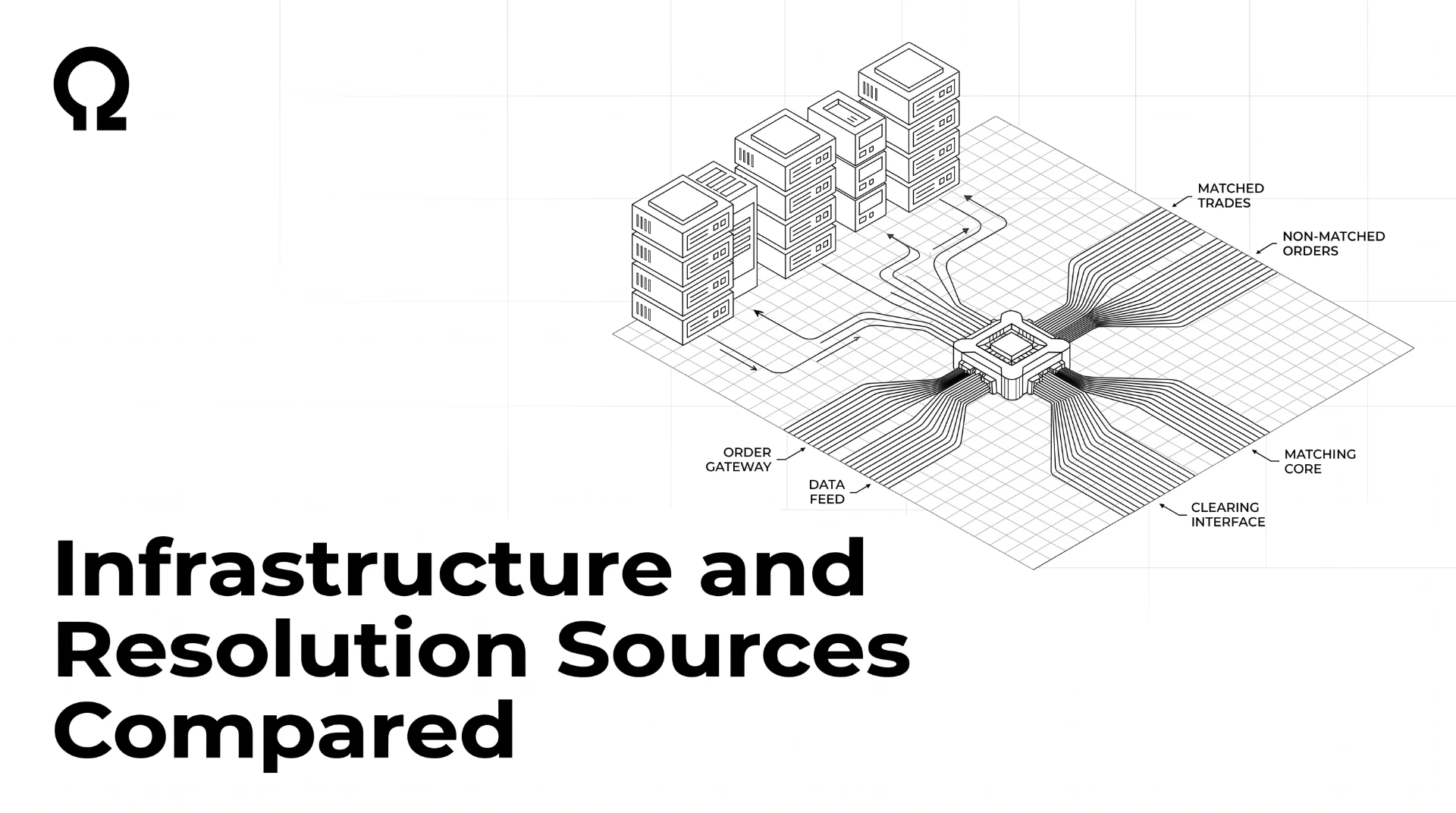
Two venues can run the same market on the same day and still not be running on the same thing. One question is where the order actually gets matched, a physical or cloud-region fact. A separate question is which real-world source decides who won, an institutional fact that has nothing to do with servers. Both matter, and they don't move together.
Where matching actually happens
Not every venue Convex Lake covers even has a “server location” in the same sense. They split into three different architectures.
Centralized matching engines, a findable cloud region. Kalshi's matching engine runs in AWS us-east-2, the Ohio region, confirmed independently by more than one latency-testing source. Deribit's engine is reported in London. Binance's fastest observed response comes from AWS Tokyo (ap-northeast-1), consistent with a matching engine there, though Binance doesn't publish this the way a regulated exchange might, so treat it as an inference from response times, not a confirmed statement. All three work the way a traditional exchange works: a centralized engine somewhere specific, and being physically or network-closer to it is a real latency edge for anyone trading at that scale.
Off-chain matching, on-chain settlement. Polymarket's order book matches off-chain, in AWS eu-west-2 (London). Orders are signed intents (EIP-712), not on-chain transactions, and matched trades settle atomically through an audited contract on Polygon. Predict.fun runs the same basic shape: an off-chain central limit order book pairing maker and taker orders, settling into on-chain conditional tokens on BNB Chain. Predict.fun's team includes former Binance infrastructure engineers, but the specific cloud region behind its matching layer isn't publicly disclosed anywhere this research found, worth knowing as a real gap rather than assuming it mirrors Polymarket's setup.
Fully on-chain matching. Limitless runs its order book matching itself on Base, Coinbase's L2. There's no separate off-chain layer to locate; the matching is the chain.
The practical read: Kalshi, Deribit, and Binance reward being close to one specific place. Polymarket and Predict.fun add a settlement step that a purely centralized exchange doesn't have. Limitless removes the “where's the server” question entirely, replacing it with “how fast is the chain.”
Resolution sources, by category
This is the part that doesn't correlate with server geography at all. Two venues can share a cloud region and still resolve the same category of market against completely different sources.
Elections. Kalshi licenses the Associated Press's election data directly, a deal confirmed starting with the 2026 midterms. Polymarket's rule is structurally different: it requires the AP, Fox News, and NBC to all call a race for the same candidate before resolving; if the three don't converge, the market falls back to official certification instead. One venue leans on a single licensed source. The other requires three independent outlets to agree first, and only reaches for certification as backup.
Crypto price markets. Kalshi's short-dated crypto markets settle against the CF Benchmarks Real Time Index, an aggregate across multiple exchanges rather than any single feed. Polymarket's 5-minute and 15-minute crypto markets settle via Chainlink Data Streams, oracle-reported prices with automation triggering settlement at preset times. Polymarket uses Pyth specifically for its newer equities and commodities markets. An aggregated index and an oracle network aren't the same thing; they can diverge on a fast-moving print, even measuring “the same” price at “the same” moment.
Economic data. This is the one category where the sources actually line up. Kalshi's CPI, jobs, and Fed-rate-decision markets settle against the official published figure at release: the BLS's own number for CPI, the FOMC's own statement for a rate decision. There's only one real source for a number like this to begin with, so both venues effectively point to the same thing here. Worth including precisely because it shows the differences elsewhere aren't just a pattern this piece is inventing.
Sports. Kalshi and Polymarket both now use Genius Sports as an official data provider. Kalshi's deal covers a portfolio including the Premier League, Ligue 1, and Liga MX; Polymarket's covers Serie A specifically, plus integrity services and streaming rights. Same underlying provider, different per-league scope. The bigger gap here isn't the source, it's what happens when a result is genuinely ambiguous: Kalshi resolves centrally against its predetermined official source, full stop. Polymarket's disputed markets go to a vote by UMA token holders, a different kind of authority altogether.
Weather. Kalshi settles off the NWS Daily Climate Report consistently across cities. Polymarket's source varies by city: Wunderground for some, NOAA or weather.gov directly for others, sometimes even a different physical station. Our 102-city-day comparison measures how often those differences change the reported result.
The structural difference underneath all of it
Every category above traces back to the same root split. Kalshi is a CFTC-regulated exchange with the standing to resolve against a predetermined source and have that be final. Polymarket doesn't have that kind of centralized regulatory authority, so it needs a fallback mechanism for when its primary rule doesn't cleanly resolve something, and that fallback is a decentralized, token-weighted vote. That's not a minor implementation detail. It's why Polymarket's election rule needs three sources to agree in the first place: the less centralized authority a venue has to just declare an answer, the more its primary rule has to be built to avoid needing the fallback at all.
What this means for cross-venue research
If a research question or strategy only ever touches one venue, none of this matters day to day. It matters the moment you're comparing implied probabilities across venues as if they're pricing the same underlying event, or building anything that depends on a market resolving the way you expect near a genuinely close call. The venues aren't running the same infrastructure, and for anything that isn't a single-official-source category like economic data, they're often not running the same resolution logic either. Server geography and resolution authority are two separate questions, and confusing them is the easiest way to misjudge how comparable two venues' prices actually are.
Historical and real-time data across all six venues, order books, trades, and the underlying market metadata, is available under one schema through the API docs.
FAQ
Does being closer to a venue’s servers actually matter for anything other than HFT?
Mostly no. For categories that resolve against an external institutional source, latency to the matching engine changes execution speed, not what data resolves the market.
Why does Polymarket need three news outlets to agree on an election, when Kalshi only needs one?
Kalshi has direct, licensed, regulator-backed standing to declare a resolution. Polymarket does not have that same centralized authority, so its primary rule requires strong, converging evidence before resolving without a vote.
Do Limitless and Predict.fun use the same resolution sources as Kalshi or Polymarket?
That was not verified to the same depth here. Their infrastructure is covered, but category-by-category resolution rules need the same direct verification before making a specific claim.
Is a CF Benchmarks index more or less reliable than a Chainlink oracle for a crypto price market?
Neither is inherently more reliable. An aggregated index smooths across multiple exchanges, while an oracle network reports and can trigger automated settlement in near real time.
What happens on Polymarket when a market’s outcome is genuinely disputed?
It goes to UMA, a decentralized oracle protocol where token holders vote on the correct resolution. That is a fundamentally different final authority from Kalshi’s centralized, regulator-backed resolution.